Will AI Replace DevOps Engineers? The Truth Every DevOps Professional Must Know in 2026 (Part 3)
Your 2026–2030 Roadmap, Salary Trends, Career Advice, FAQs & Final Thoughts
In Part 1, we explored why AI has created fear across the DevOps community and why so many professionals are questioning the future of their careers.
In Part 2, we separated fact from fiction by identifying the tasks AI can automate and the responsibilities that still require human expertise.
Now comes the most important question:
How do you prepare for the next five years?
Technology has always rewarded engineers who adapt early. Cloud computing, containers, Kubernetes, Infrastructure as Code, and CI/CD all created new opportunities for professionals willing to learn.
Artificial Intelligence is no different.
The future belongs to engineers who combine technical expertise with AI — not to those who ignore it.
Let’s build a roadmap that keeps your career relevant through 2030.
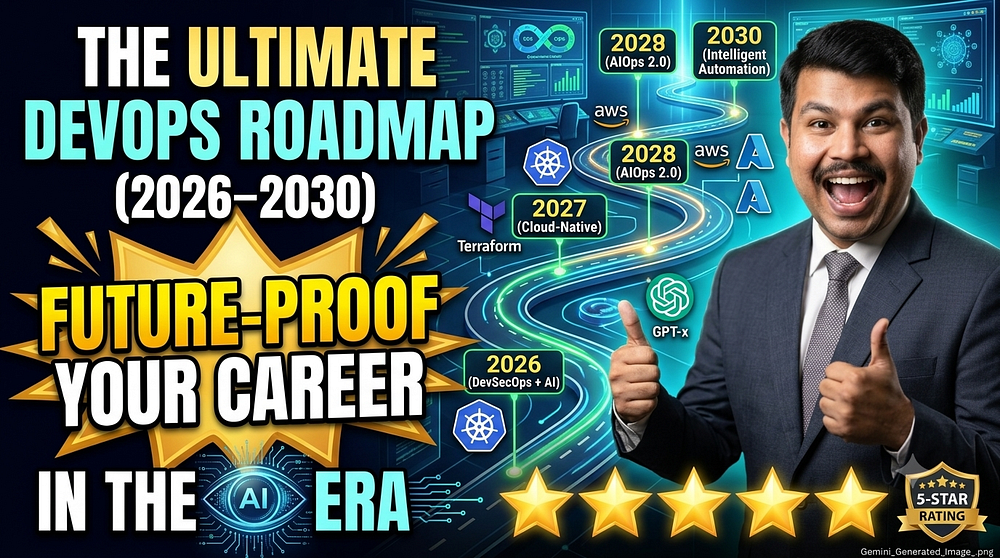
The Future DevOps Engineer
The DevOps engineer of 2030 will look very different from the DevOps engineer of 2020.
Five years ago, success meant learning tools.
Today, success means learning systems.
Tomorrow, success will mean learning how to use AI to design, automate, secure, and optimize those systems.
Companies are no longer searching for engineers who simply deploy applications.
They want professionals who can:
- Build resilient cloud platforms.
- Improve developer productivity.
- Reduce cloud costs.
- Strengthen security.
- Automate operations with AI.
- Support business growth through reliable infrastructure.
The role is becoming more strategic than ever before.
The Skills That Will Be in High Demand (2026–2030)
If you’re planning your learning journey, these are the skills worth investing in.
1. Cloud Platforms
Master at least one major cloud provider.
Recommended options:
- AWS
- Microsoft Azure
- Google Cloud Platform (GCP)
Understand networking, compute, storage, IAM, monitoring, security, and cost optimization.
Cloud knowledge remains the foundation of modern DevOps.
2. Kubernetes
Kubernetes is no longer an optional skill.
Learn:
- Cluster architecture
- Networking
- Ingress
- Storage
- Helm
- Autoscaling
- Security
- Monitoring
- Troubleshooting
Companies continue to migrate workloads to Kubernetes, making it one of the most valuable DevOps skills.
3. Infrastructure as Code
Automation is the backbone of DevOps.
Focus on:
- Terraform
- OpenTofu
- CloudFormation (AWS)
- Bicep (Azure)
Don’t just learn syntax.
Learn how to design reusable, scalable infrastructure modules.
4. Programming & Automation
Every modern DevOps engineer should be comfortable writing code.
Recommended languages:
- Python
- Bash
- PowerShell
- Go (optional but valuable)
Programming allows you to automate repetitive work and integrate AI into your workflows.
5. DevSecOps
Security is becoming everyone’s responsibility.
Learn:
- IAM best practices
- Secret management
- Container security
- Kubernetes security
- Image scanning
- Vulnerability management
- Policy as Code
The engineers who understand security will always stand out.
6. AI-Powered DevOps
This is the biggest opportunity of the decade.
Learn how to use AI for:
- Infrastructure generation
- Pipeline creation
- Documentation
- Incident investigation
- Log analysis
- Automation
- Infrastructure optimization
Remember:
Using AI effectively is becoming a competitive advantage.
7. MLOps Fundamentals
Even if you don’t become a Machine Learning Engineer, understanding MLOps will increase your value.
Learn:
- Model deployment
- Model versioning
- GPU infrastructure
- Vector databases
- AI inference
- Model monitoring
- AI application deployment
AI applications need reliable infrastructure — and DevOps engineers are perfectly positioned to build it.
Salary Trends: Where Is the Market Heading?
One of the biggest concerns among engineers is salary.
Will AI reduce salaries?
The answer depends on your skills.
Entry-Level Engineers
Engineers who rely only on repetitive scripting and manual configuration may face increased competition as AI handles more routine work.
To remain competitive, they will need to develop stronger cloud, automation, and architecture skills.
Mid-Level Engineers
Professionals who embrace AI can significantly increase their productivity and become more valuable to employers.
Organizations are increasingly rewarding engineers who can automate workflows and improve operational efficiency.
Senior Engineers
Senior DevOps engineers who combine cloud architecture, security, leadership, and AI-assisted automation are expected to remain in strong demand.
Their value comes from making strategic decisions, not simply writing configuration files.
The biggest salary growth over the next five years is likely to come from professionals who combine:
- DevOps
- Cloud
- Kubernetes
- Security
- AI
- Platform Engineering
That combination is becoming one of the strongest profiles in the technology industry.
Career Advice for Beginners
If you’re just starting your DevOps journey, don’t let AI discourage you.
Instead, let it accelerate your learning.
Use AI to:
- Explain difficult concepts.
- Review your scripts.
- Practice interview questions.
- Build projects.
- Generate documentation.
- Learn faster.
But never copy code blindly.
Understand every command before using it in production.
AI should improve your thinking — not replace it.
Career Advice for Experienced Engineers
If you’ve been working in DevOps for several years, your biggest asset isn’t your ability to write YAML files.
It’s your experience.
Your ability to:
- Solve production problems.
- Design reliable systems.
- Lead incidents.
- Mentor teams.
- Make architectural decisions.
These skills become even more valuable in an AI-driven world.
Don’t compete with AI.
Use AI to eliminate repetitive work so you can focus on high-impact engineering.
A Practical Learning Roadmap
If you want to stay ahead between now and 2030, consider this progression:
Stage 1 — Build the Foundation
- Linux
- Networking
- Git
- Python
- Docker
Stage 2 — Master Cloud
- AWS, Azure, or GCP
- IAM
- Networking
- Monitoring
- Storage
Stage 3 — Learn Modern DevOps
- Kubernetes
- Terraform
- CI/CD
- Observability
- GitOps
Stage 4 — Add Security
- DevSecOps
- Policy as Code
- Secrets Management
- Compliance
Stage 5 — Learn AI Integration
- AI-assisted automation
- Prompt engineering for DevOps
- AI infrastructure
- MLOps basics
- AI application deployment
By following this roadmap, you’ll develop skills that remain valuable regardless of how AI evolves.
Frequently Asked Questions
Will AI completely replace DevOps Engineers?
No.
AI will automate repetitive tasks, but experienced engineers are still needed to design architectures, manage production systems, solve complex incidents, improve security, and make business-critical decisions.
Is DevOps still a good career in 2026?
Absolutely.
The role is evolving rather than disappearing.
Engineers who embrace cloud technologies, Kubernetes, security, automation, and AI are expected to remain in strong demand.
Should I learn AI instead of DevOps?
You don’t have to choose one over the other.
The most valuable professionals will combine both skill sets.
AI + DevOps is likely to become one of the strongest career combinations over the next decade.
Which skill should I learn first?
Start with:
- Linux
- Networking
- Git
- Python
- Docker
Then move toward cloud platforms, Kubernetes, Terraform, CI/CD, security, and AI-powered automation.
Strong fundamentals always outperform chasing the latest trend.
Final Thoughts
Every technological revolution creates uncertainty.
When cloud computing emerged, people feared it would eliminate system administrators.
Instead, it created cloud engineers.
When containers became popular, many believed traditional deployment jobs would disappear.
Instead, Kubernetes opened thousands of new career opportunities.
Artificial Intelligence is following the same pattern.
The engineers who resist change may struggle.
The engineers who embrace AI will become faster, smarter, and more valuable than ever before.
The real question is no longer:
“Will AI replace DevOps Engineers?”
The better question is:
“Will you evolve faster than the technology around you?”
Your career isn’t defined by the tools you use.
It’s defined by your ability to learn, adapt, and solve problems.
And that is something no AI can fully replace.
Thank You for Reading
If you found this article helpful, consider sharing it with fellow DevOps engineers, cloud professionals, and students who are wondering what the future holds.
The AI revolution is not the end of DevOps.
It’s the beginning of a new generation of DevOps Engineers — those who know how to combine human expertise with Artificial Intelligence.
The future is already here.
The best time to prepare for it is today.


Comments
Post a Comment